
When Dependencies Timeout, Does Your API Shed Load with 429 Responses?
By Naresh Jain
When Dependencies Timeout: Engineering Tests that Produce a 429 response
Simulating backend slowdowns and verifying that your API returns a proper 429 response is a practical way to ensure graceful degradation in production traffic spikes. A well-crafted mock can reproduce timeout conditions, trigger rate-limit logic, and validate retry and fallback behavior without hammering real services.
Why simulate timeouts and 429 responses?
Real-world systems fail in predictable and unpredictable ways. One common pattern is downstream services slowing down or timing out under load. When that happens, the surface-level API should avoid cascading failures and instead shed load where appropriate. Testing for a 429 response exercise verifies:
- Client-side resilience — retry and backoff policies behave as expected.
- Server-side control — the API returns a clear “too many requests” signal rather than stalling.
- Workflow correctness — fallbacks and recovery paths are exercised automatically in CI.
How transient expectations help
A transient expectation in a mock is a rule that matches a specific incoming request and returns a predefined response only once. Use this to reproduce a short-lived event such as an intermittent timeout that causes the client to receive a 429 response and then recover on the next attempt.

Key benefits of transient expectations:
- Single-shot failures — simulate flakiness without permanently changing mock behavior.
- Deterministic testing — tests can observe both the failure and the recovery in one run.
- Fine-grained control — combine conditions like request fields and page size to trigger specific scenarios.
Step-by-step: configure a mock to produce a 429 response
The simplest pattern is: match a specific request, delay its response past your client timeout, and mark that rule as transient so subsequent requests succeed.
- Target a narrow request — match a particular resource type and parameters (for example, type=other and pageSize=20).
- Set a delay — configure the mock to delay the response by longer than your client timeout (for example, 2 seconds if the client times out at 1 second).
- Mark as transient — ensure the mock rule is used only once so a retry returns the normal 200 path.
- Run the test — assert the first attempt results in a 429 response and that an automatic retry or subsequent call returns 200.
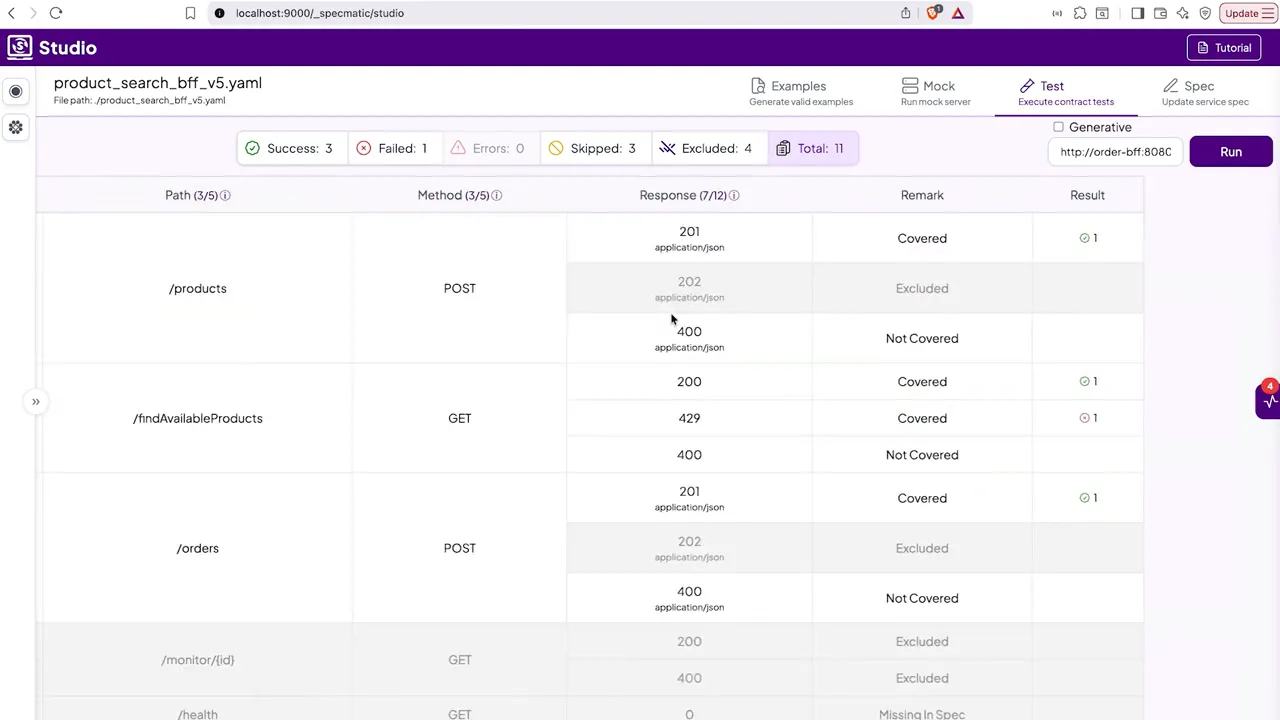
This approach lets you simulate the exact moment a dependency causes a timeout and observe how your BFF or API gateway reacts — whether it returns a 429 response, fails silently, or blocks further requests.
Example walkthrough
In practice you would:
- Disable any generative or catch-all mock that would interfere with targeted rules.
- Create an expectation matching the incoming payload where type=other and pageSize=20. Leave other fields generic if they do not matter.
- Set delayInSeconds to exceed the client timeout and mark the expectation as transient.
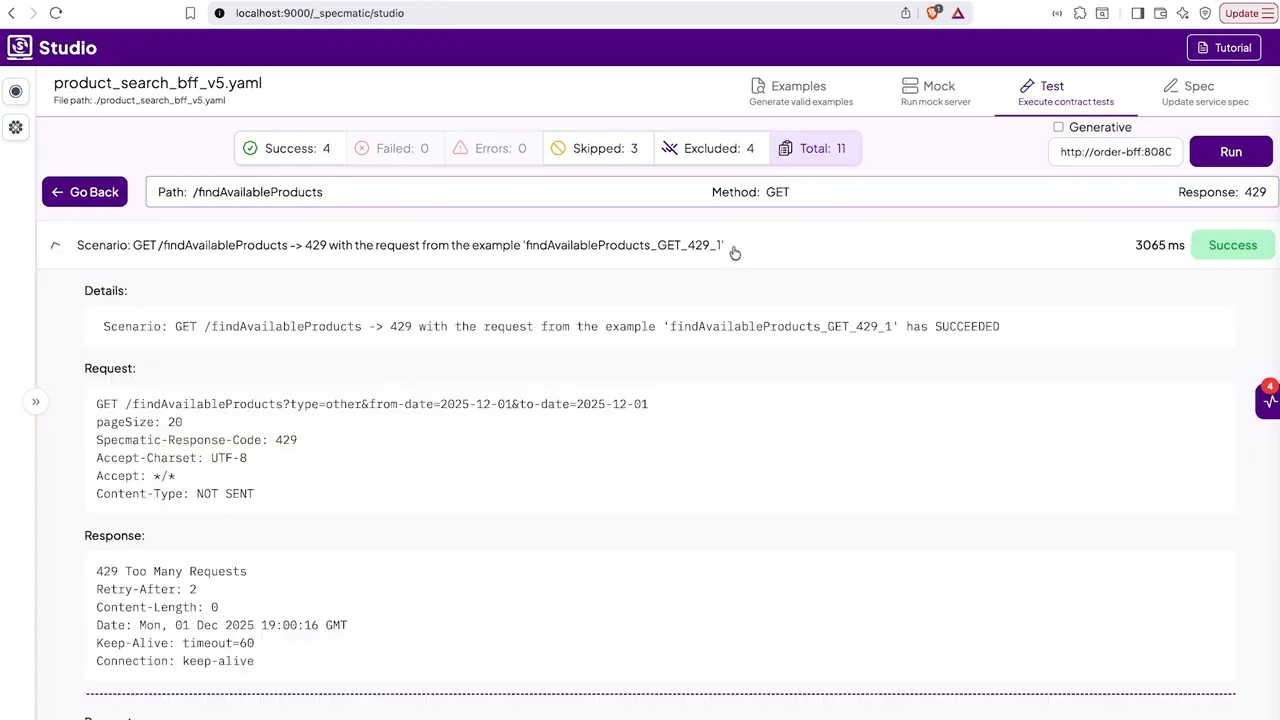
- Run the test and observe the client timing out and returning a 429 response. Then confirm a subsequent retry receives the normal 200 response because the transient expectation no longer applies.
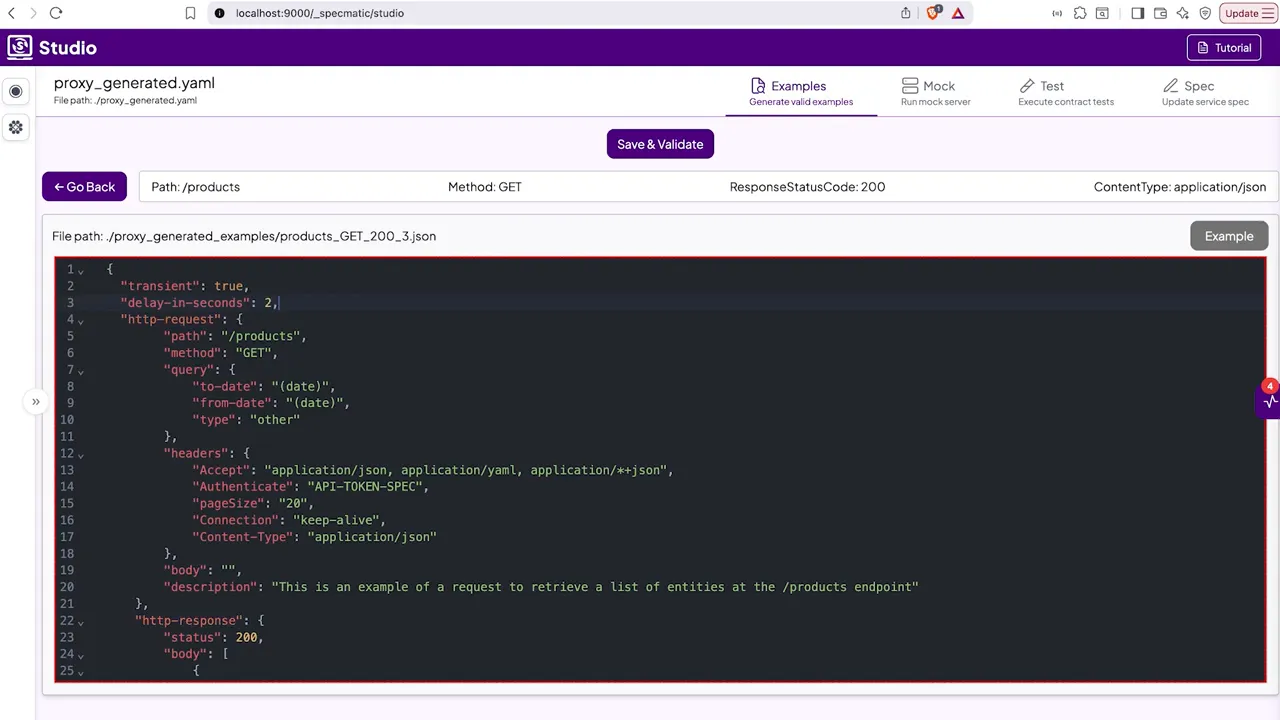
The first request will be purposely delayed, triggering the timeout and a 429 response. The next request falls through to the default mock expectation and returns a 200. This reproduces a realistic pattern: temporary overload followed by recovery.
What this validates
Running this test verifies multiple behaviors without requiring heavy load testing:
- That your API translates downstream timeouts into a recognisable 429 response.
- That retry logic is correctly implemented and does not amplify load during transient issues.
- That fallbacks and cached responses are used when appropriate.
Best practices
- Be specific when matching requests to avoid accidental rule collisions.
- Keep transient rules short-lived so tests remain repeatable and deterministic.
- Use realistic delays—simulate real client timeouts rather than extreme values that do not map to production settings.
- Automate these checks as part of CI so regressions in retry and rate-limit handling are caught early.
How does a transient expectation differ from a normal mock rule?
A transient expectation is consumed the first time a matching request arrives and will not apply afterward. A normal mock rule persists and will respond the same way to every matching request.
Can I simulate multiple consecutive timeouts that cause repeated 429 responses?
Yes. Create several transient expectations or configure rules with a counter to match the desired number of failures before recovery. Each transient rule can represent one failure event.
What should I assert in my tests when simulating timeouts?
Assert that the client or gateway returns the expected 429 response on the delayed attempt, that retry logic triggers (if expected), and that subsequent requests return a successful status like 200. Also verify any backoff intervals and logging.
Is it safe to rely on mocked 429 responses for production readiness?
Mocked scenarios are a critical part of preproduction verification but should be complemented with targeted chaos and load tests in staging to ensure the system behaves under real network and load conditions.
Related Posts

By Naresh Jain
gRPC Flaws – The Illusion of Safety & Frustrating DevEx in Proto3’s Type-Safe Contracts

By Naresh Jain
Achieving Seamless DevEx: API Specification and Code Generation with API Genie

By Joel Rosario
API Resiliency and Contract Testing for GraphQL

By Naresh Jain
Contract Testing using OpenAPI Specs as Executable Contracts

By Hari Krishnan
WireMock’s Dirty Secret: Ignoring API Specs & Letting Invalid Examples Slip Through
By Naresh Jain
When Downstream Services Lag, Does Your API Gracefully Accept with 202 Responses?

By Yogesh Nikam
Contract Testing using gRPC Specs as Executable Contracts

By Naresh Jain
Replace Live Services with OpenAPI Mocks from Real HTTP Traffic with Specmatic Proxy

By Jaydeep Kulkarni
Curate, Validate and Publish an MCP Server from an OpenAPI Spec with Specmatic Genie

By Yogesh Nikam