
Achieving Seamless DevEx: API Specification and Code Generation with API Genie
By Naresh Jain
Imagine turning a plain-English business requirement into a working API without writing a single line of code. That is the promise of modern natural-language driven API design tools: describe what you need, iterate on the specification, prototype endpoints, and automatically generate production-ready code and contract tests. The result is a faster path from idea to validated API design that keeps teams aligned and reduces rework.
Why rethink API design?
Traditional API design often starts with lengthy meetings, back-and-forth documents, and manual spec writing. That slows down discovery and makes it harder to experiment. A natural-language driven approach lets you capture intent quickly, validate assumptions through runnable prototypes, and evolve the API as requirements change.
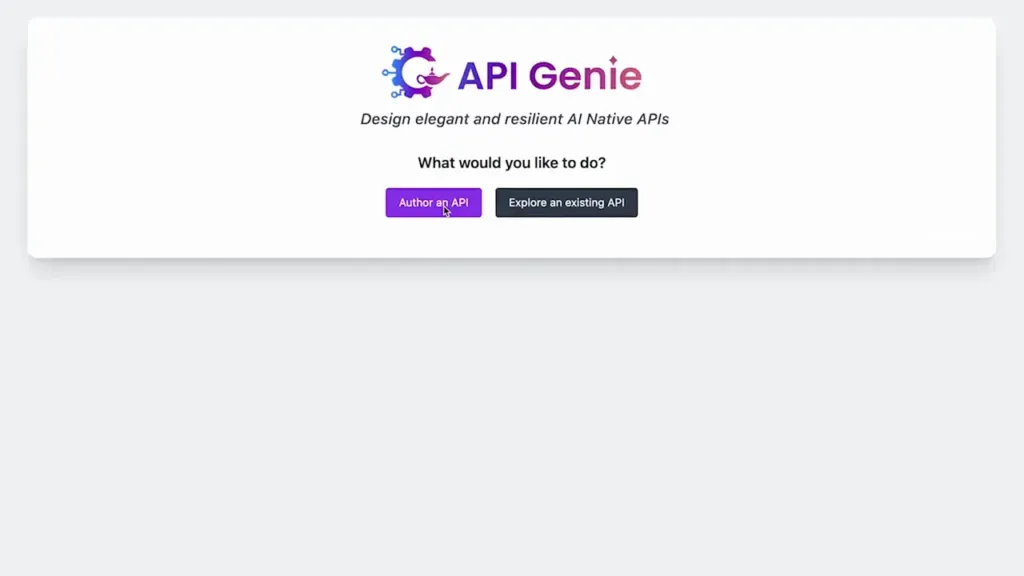
Turn business requirements into a living specification
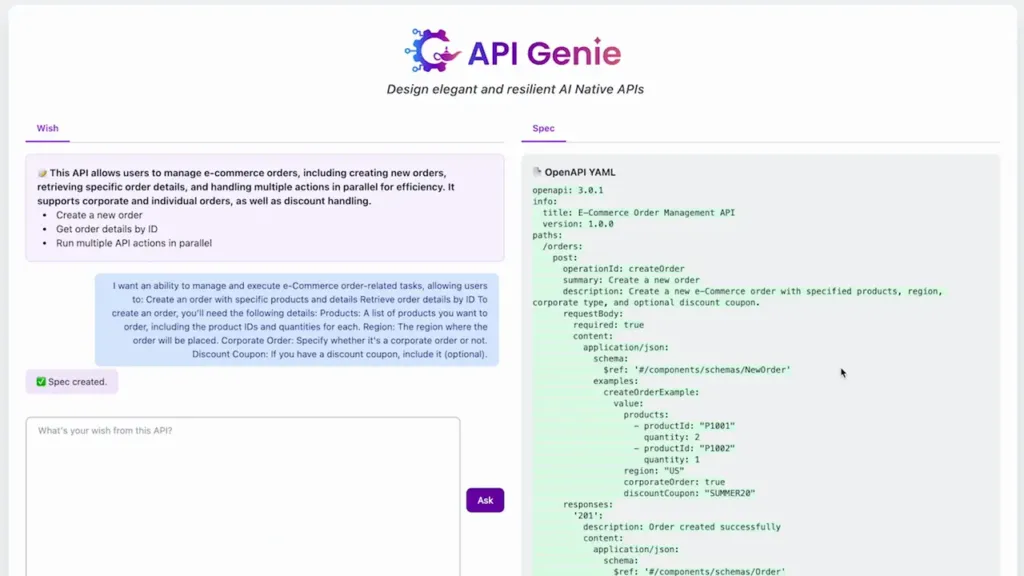
Start by describing the business capabilities you need in plain language. For example: “I need an e-commerce order API that can create an order with product and region details, retrieve an order by ID, and eventually list all orders.” The system parses this requirement, generates an OpenAPI specification, and presents a summary of available operations.
That generated specification is not a static document. It is a living artifact you can interact with immediately. You can call endpoints, inspect example responses, and refine the spec as new needs emerge. This tightens the feedback loop and keeps the focus on delivering useful behavior rather than debating formats.
Prototype and validate with instant API calls
Once the spec exists, you can exercise it. Fetch an order, create one, then retrieve the newly created order back. The prototype behaves like a working service, so you can validate flows end to end. This hands-on approach helps uncover missing capabilities quickly. For example, if you realize you need an endpoint to list all orders, add that requirement and the spec updates itself to include the new route.
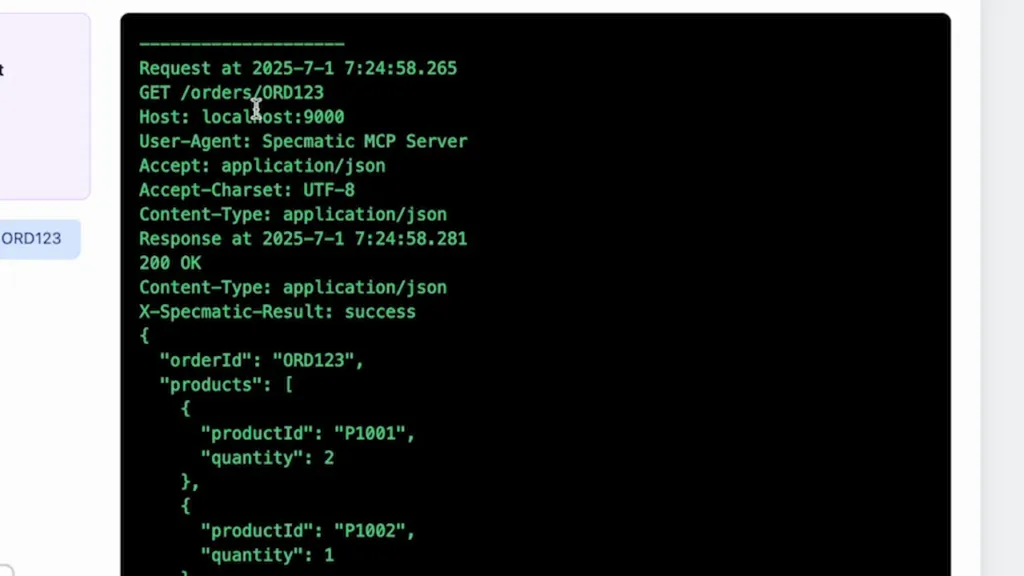
Prototyping this way makes the API design process iterative and discovery-driven. Instead of finalizing a huge spec up front, you evolve it with small, testable steps.
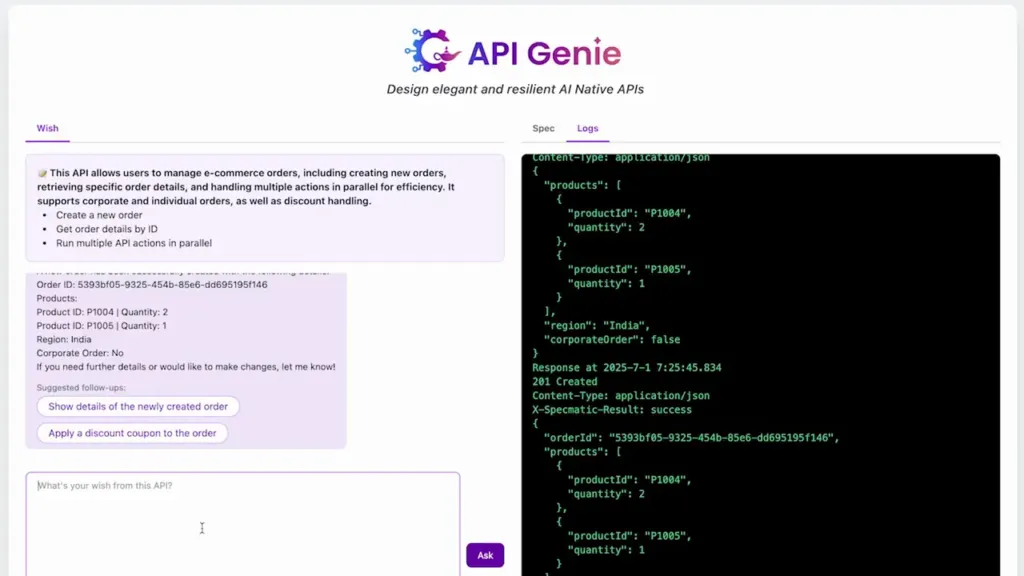
Iterate the spec like code
Treat the specification as the single source of truth. When you add a new endpoint or change a payload shape, the tool highlights what changed and why. That visibility reduces miscommunication between product, design, and engineering teams.
This also supports contract-driven development: once a spec is stable, it becomes the contract for both clients and servers. Developers can work against the contract with confidence that the generated code and tests will enforce it.
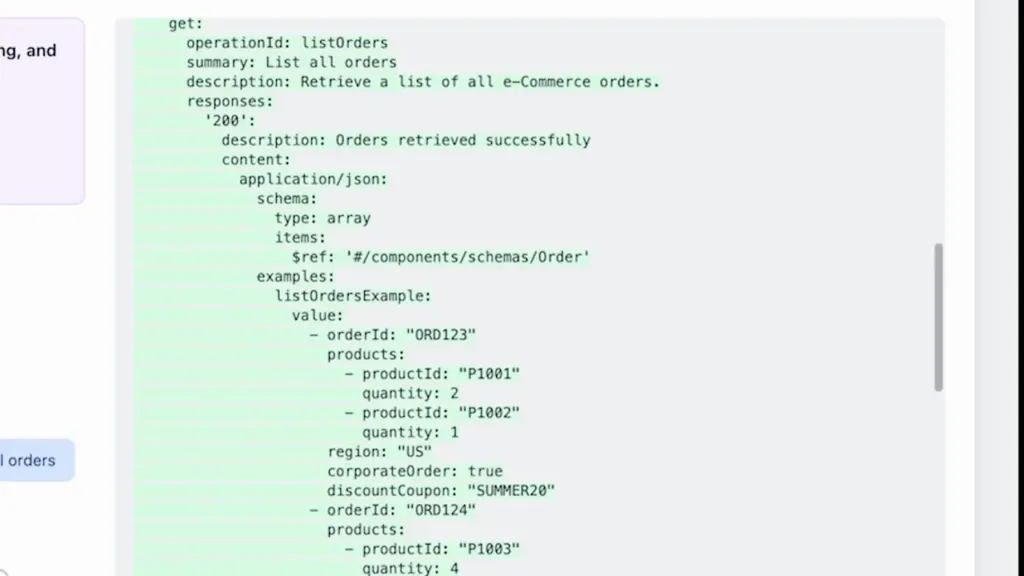
Generate production-ready code from the spec
When you are satisfied with the specification, feed it to a code generator. Choose your preferred runtime—Node, Java, or any supported stack. The generator translates the OpenAPI specification into an application skeleton, complete with route handlers, validation logic, and example payloads.
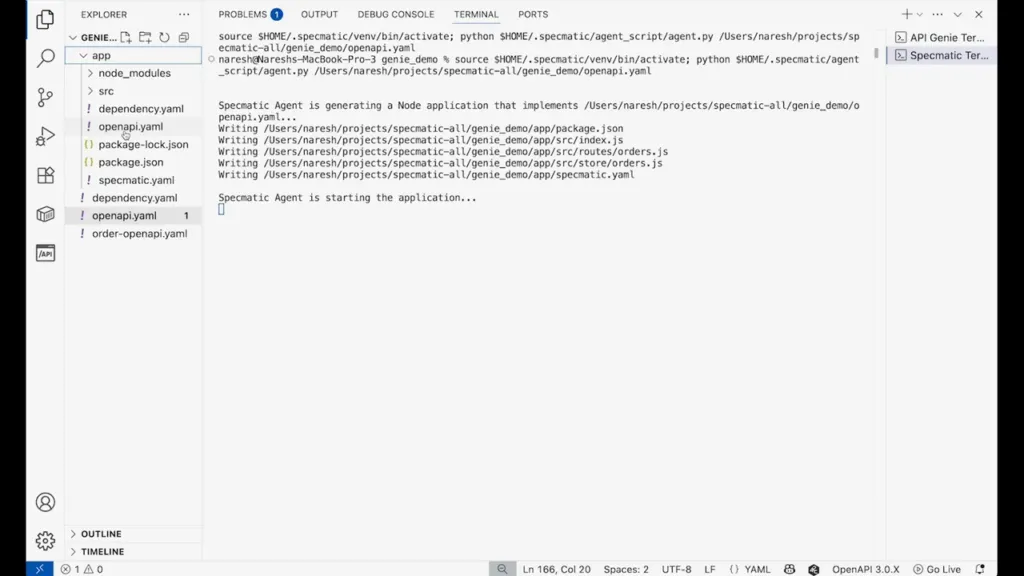
The key benefit is consistency. The generated application aligns with the spec exactly, which reduces the time engineers spend wiring up trivial details and lets them focus on business logic.
Automated contract testing keeps the feedback tight
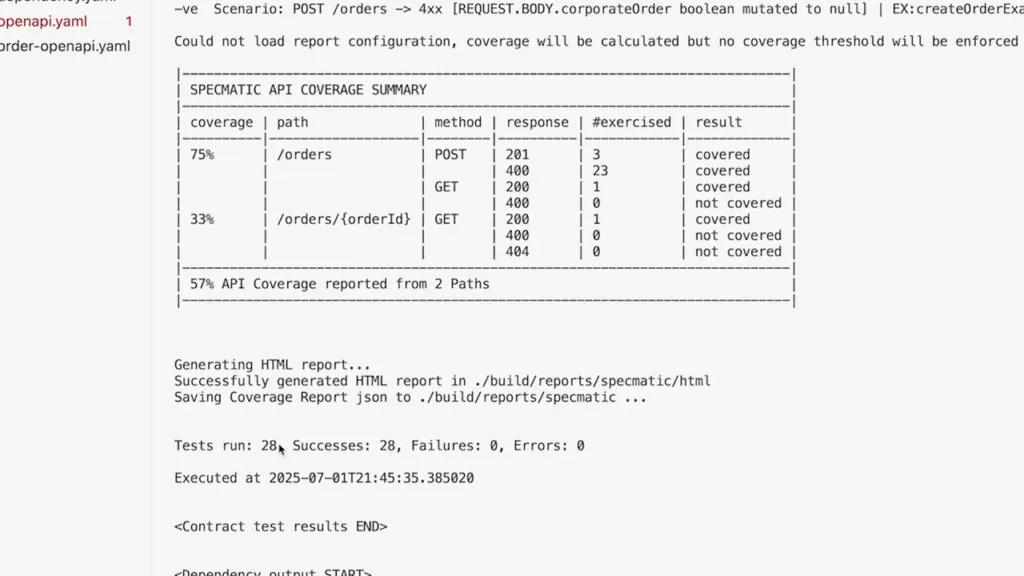
Code generation is only half the story. A contract-testing agent launches the generated app and runs a battery of tests derived from the specification. These tests verify that the implementation honors every contract detail: endpoints, request and response schemas, status codes, and edge cases.
Expect an iterative loop here. Some generated implementations will fail tests initially. The testing agent summarizes failures and feeds that feedback back to the generator or developer. With a few iterations the implementation becomes compliant. This loop is what turns a rough prototype into a robust, spec-compliant service.
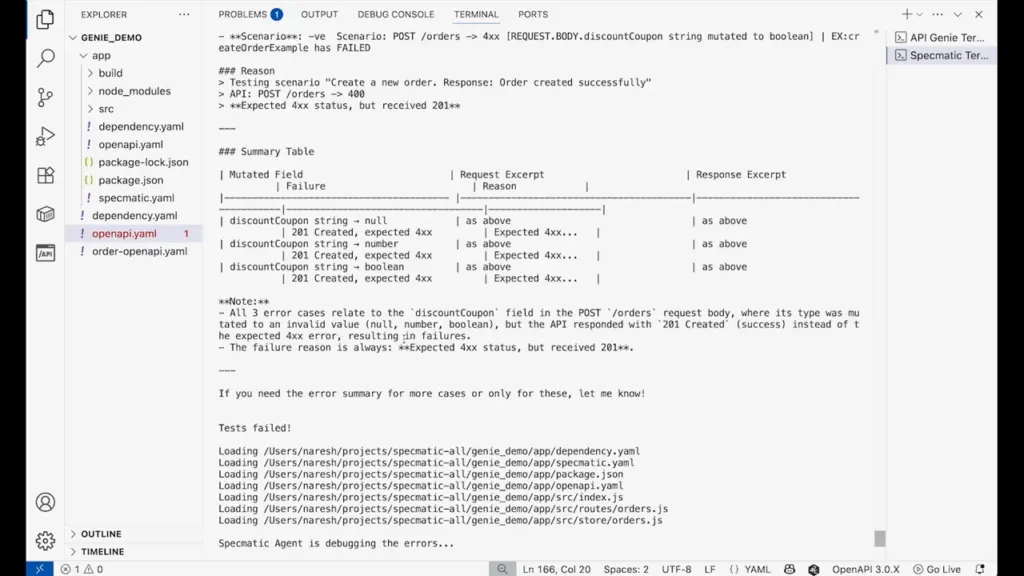
In practice this means you can go from concept to a fully tested API implementation quickly while keeping the API design authoritative and contract-driven.
Practical tips for working with natural-language driven API design
- Start with clear business intents — Describe core actions and important data fields. Precise natural language leads to cleaner specs.
- Prototype early and often — Use the runnable spec to discover missing endpoints and edge cases before any code is written.
- Keep the spec central — Treat the OpenAPI spec as the contract. Generate code and tests from it so implementation and documentation stay in sync.
- Leverage contract tests — Use automated contract testing to catch mismatches early and to validate generated code across iterations.
- Iterate collaboratively — Let product managers, QA, and engineers refine the spec together so the API design reflects shared understanding.
Common pitfalls and how to avoid them
Avoid vague requirements. Phrases like “support multiple product types” need concrete examples. Supply sample payloads and expected behaviors. That reduces ambiguity the generator must resolve.
Do not treat generation as a one-time event. Generated code is a starting point that benefits from human review and refinement to handle nonfunctional requirements such as observability, error handling, and performance.
Conclusion
Moving to a natural-language centric workflow transforms how teams approach API design. By converting plain-English requirements into runnable specs, prototyping endpoints, and generating contract-validated code, teams compress the feedback loop and reach production-quality APIs faster.
The combination of iterative spec evolution, automated code generation, and contract testing creates a repeatable, low-friction process for building reliable APIs that align with business intent.
How does natural-language input become a formal API specification?
Natural-language requirements are parsed and transformed into an OpenAPI specification using an LLM assisted workflow. The tool extracts endpoints, request and response shapes, and example payloads, then presents an editable spec for validation.
Can I customize generated code to match my architecture?
Yes. Generated code is intended as a compliant scaffold. You can extend it with your own middleware, logging, authentication, and deployment configurations while preserving the contract enforced by tests.
How reliable are the contract tests?
Contract tests are derived directly from the specification and verify schema, status codes, and behavioral expectations. They are an effective guardrail but should be complemented by integration and performance tests for production readiness.
What happens when the generated code fails tests?
Failure triggers an automated feedback loop. The testing agent summarizes errors and the generator attempts fixes. Iterations continue until tests pass or a human adjusts the spec or implementation.
Related Posts
By Naresh Jain
gRPC Flaws – The Illusion of Safety & Frustrating DevEx in Proto3’s Type-Safe Contracts
By Naresh Jain
Replace Live Services with OpenAPI Mocks from Real HTTP Traffic with Specmatic Proxy
By Joel Rosario
API Resiliency and Contract Testing for GraphQL

By Naresh Jain
Contract Testing using OpenAPI Specs as Executable Contracts
By Hari Krishnan
WireMock’s Dirty Secret: Ignoring API Specs & Letting Invalid Examples Slip Through
By Naresh Jain
When Dependencies Timeout, Does Your API Shed Load with 429 Responses?
By Yogesh Nikam
Contract Testing using gRPC Specs as Executable Contracts
By Naresh Jain
When Downstream Services Lag, Does Your API Gracefully Accept with 202 Responses?
By Jaydeep Kulkarni
Curate, Validate and Publish an MCP Server from an OpenAPI Spec with Specmatic Genie
By Yogesh Nikam